Towards a Regular Dialogue Platform between the United Nations and the Private Sector
UN and Congo’s private sector commit to a regular dialogue platform to accelerate SDGs and foster sustainable, inclusive development.
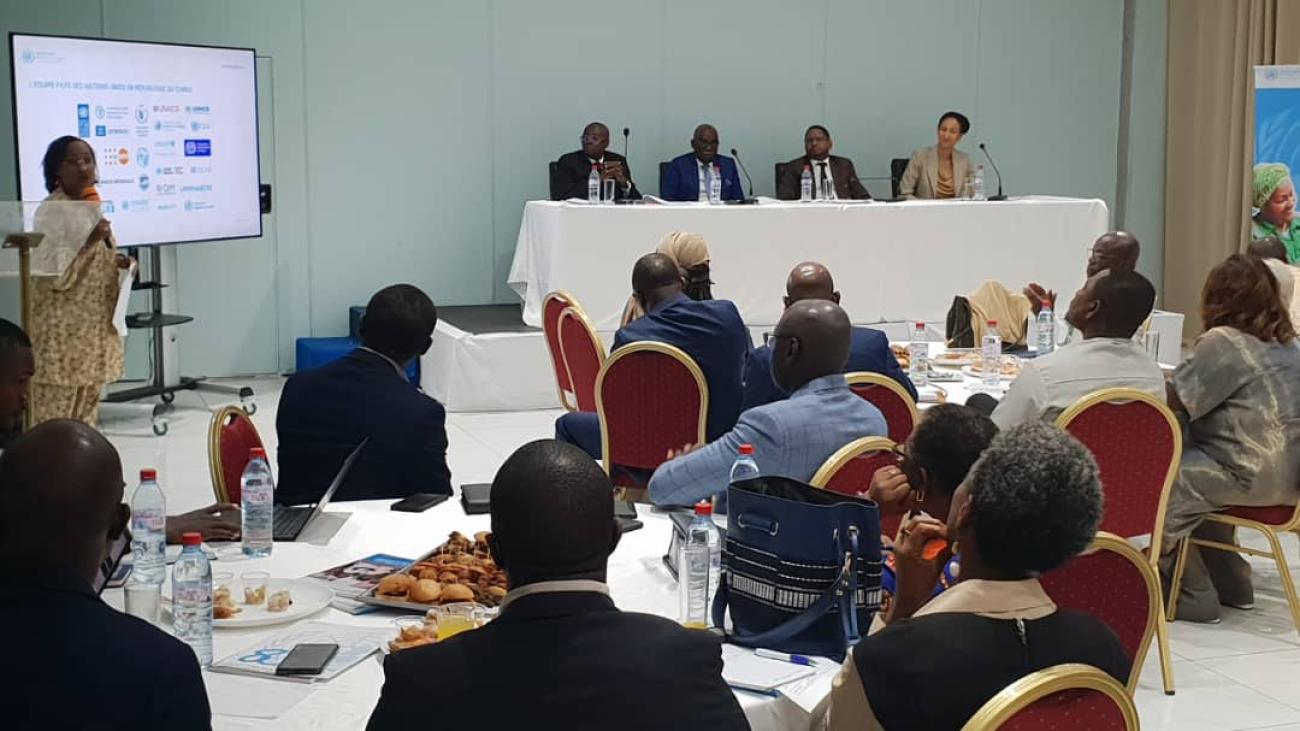
On April 2, 2025, in Pointe-Noire, the United Nations System and the private sector in the Republic of the Congo committed to establishing a platform for regular dialogue aimed at accelerating the implementation of the Sustainable Development Goals (SDGs). This commitment followed a working session attended by around one hundred entrepreneurs, including the Presidents of the National Union of Economic Operators of Congo (UNOC), the Chamber of Commerce, Industry and Trades (CCIAM) of Pointe-Noire, the Secretary-General of the Interprofessional Union of Congo (UNICONGO), as well as the UN Resident Coordinator and Heads of UN agencies.
During the exchanges—preceded by opening remarks and presentations—participants welcomed the initiative and learned about the 2019 UN Reform and ongoing private sector projects. The United Nations System in Congo includes 20 agencies, 10 of which are resident and 10 non-resident. Its coordinated work, under the 2020–2026 Cooperation Framework, focuses on Governance, Education, Health, and Economic Diversification.
Recognizing the UN’s commitment to supporting the private sector, which is central to achieving the 2030 Agenda and the SDGs, participants emphasized the urgency of accelerating progress toward the SDGs at both national and global levels. The private sector was encouraged to raise its voice in UN platforms (such as the UN Global Compact), co-create impactful projects—individually or in partnership—and integrate the SDGs into business strategies. Focus was placed on five key SDG accelerators: gender equality, climate action, decent wages, finance and investment, and water resilience.
Participants also discussed future funding for development activities and UN agencies, acknowledging the importance of mobilizing all sources of financing—public, private, national, and international—as outlined in the Addis Ababa Action Agenda.
Opportunities for financing projects related to gasification and forest conservation were highlighted, with references to the Green Climate Fund, the Global Environment Facility (GEF), the Blue Fund, and the Congo Basin Green Fund. Public-private-community partnerships were identified as key to successfully accessing and mobilizing these funds.
Several private sector initiatives for sustainable development were presented. One promising approach involved using biomass from forested areas for rural electrification—proposing gasification technology tailored to small-scale production and tapping into the significant energy potential of forest exploitation residues. This solution aims to reduce dependence on fossil fuels and enhance the sustainable use of natural resources.
An example of circular economy was also shared: the biological treatment and recovery of drilling sludge into charcoal, which has contributed to reducing firewood consumption in Tandou-Ngoma and Tsamba-Nzassi. In addition, the private sector is actively working on gender equality to foster a more inclusive environment for women’s participation.
Businesses were encouraged to register with the UN Global Compact platform, and the UN System in Congo expressed its readiness to support the establishment of a national Congo chapter of the Compact.
The session concluded with a mutual commitment to maintain regular dialogue—both at national and local levels—to exchange and share information on investment opportunity mapping (geographical and thematic), as well as existing good practices. Both parties also agreed to organize a dedicated United Nations–Private Sector Forum in the near future.



Written by
Prosper Mihindou Ngoma
UN entities involved in this initiative
Goals we are supporting through this initiative


